


 Mirella Pandjaitan
 Feb 25, 2026
In most desert cities, summer wins.
By midday, the streets are empty. Cars blast air-conditioning similar to refrigerators on wheels. Life migrates indoors — to offices, to homes, to malls, chilled almost theatrically below the heat outside. Being outdoors becomes something to tolerate, not savour.
In Doha, that narrative is quietly being rewritten.
Rather than surrendering to the climate, Qatar has leaned into innovation. Cooling systems now extend beyond interiors and into the public realm — misted walkways, shaded promenades, benches cooled from below, even pavements that release tempered air through discreet vents. It’s climate control reimagined as urban design.
The world caught a glimpse of this ambition during the 2022 FIFA World Cup, when air-conditioned stadiums allowed football to unfold comfortably in desert heat. But that was only the headline. The real story is how this technology has filtered into everyday life.
The intention isn’t spectacle. It’s a lifestyle.
Reinventing the desert playbook
For decades, extreme-heat destinations have leaned heavily on indoor experiences and winter high seasons. Qatar’s approach feels different. Instead of hiding from the climate, it engineers around it.
Cooling public spaces does more than create comfort — it reshapes behaviour. Tourists stay longer outdoors. Residents exercise during months that once kept them inside. Dining terraces remain viable. Public life expands.
In a region defined by sun, Qatar has made a bold suggestion: perhaps summer is not an obstacle, just a design challenge. And in true Doha fashion, the solution is equal parts innovation, spectacle, and quiet confidence.
A city that stays outside
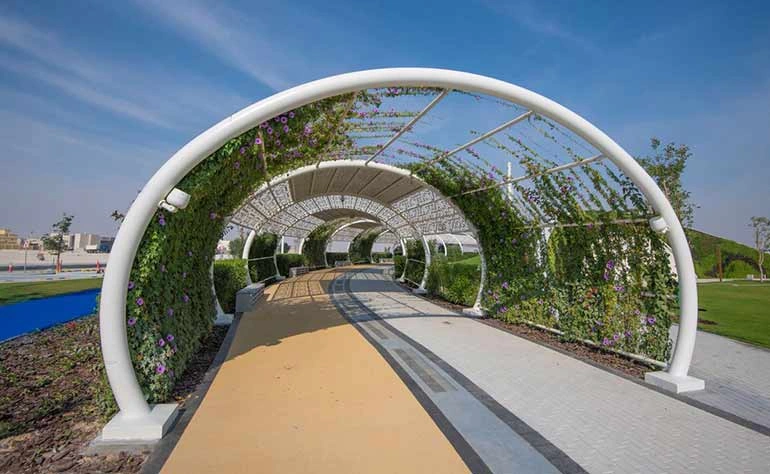
Open-air spaces are no longer seasonal luxuries reserved for winter across Doha. They’re engineered experiences.
Gatherings stretch longer at Place Vendôme Mall’s Fountain Square. Along West Walk in Al Waab, pedestrians linger instead of rushing between doorways. The outdoor retail and dining at 21 High Street in Katara feel unexpectedly comfortable beneath the Gulf sun.
Even Souq Waqif, with its winding alleys and traditional facades, feels more accessible during warmer months. Parks like Al Gharrafa Park, Oxygen Park, and Umm Al Seneem Park feature cooled jogging tracks and shaded routes that make movement possible when temperatures would normally dictate retreat. On Lusail Boulevard, strolling feels intentional rather than brave. And at Al Hazm Mall, open courtyards maintain a refined, European cadence — but with distinctly Qatari climate engineering behind the scenes.
The effect? A city that doesn’t disappear in summer.
The air-conditioned “forest”
Nowhere is this ambition more surreal than on Gewan Island.
Just off Doha’s coastline, this man-made island is home to the Crystal Walk: a 450-metre promenade cooled to a steady 21–23°C year-round. Yes, outdoors.
Above, sculptural “trees” shimmer with crystal-like structures that diffuse sunlight while helping contain cooled air flowing from vents below. Solar panels quietly convert blazing sunlight into energy. Water features invite children to splash. The temperature remains improbably pleasant.
The installation has earned Guinness World Records for both the largest outdoor air-conditioned mall and the largest interactive light canopy. But beyond the titles, what draws people back is the atmosphere. Crystal panels embedded in the ground glow with desert and marine motifs. Restaurants and cafés spill onto the promenade. Families wander slowly, not strategically.
For many visitors, the surprise is genuine. Summer, here, doesn’t sting.