

 Rani Permata
 Oct 12, 2026
When Nusantara Meets France: THE 1O1 Jakarta Sedayu Darmawangsa Reimagines Indonesian Cuisine Through French Culinary Techniques
From a Soto Betawi-inspired Velouté to chocolate paired with Sleman snake fruit, a culinary collaboration offers a fresh perspective on Indonesia’s rich gastronomic heritage
What happens when the richness of Indonesian spices and culinary heritage meets the precision and elegance of French culinary techniques?
THE 1O1 Jakarta Sedayu Darmawangsa explored this question through “Nusantara A La Francaise: Where Indonesian Heritage Meets French Technique,” a distinctive gastronomic experience that brought together Chef Yoel, Executive Chef of THE 1O1 Jakarta Sedayu Darmawangsa, and Chef Gerald Maridet, Artisan Pastry, in a culinary journey that reinterpreted Indonesian flavors through a French culinary perspective.
Held at Dwangsa9 Indonesian Restaurant, the experience featured a curated selection of dishes exploring how Indonesian ingredients, flavors, and culinary traditions can be interpreted through French techniques while preserving the character and identity of their origins.
The event was supported by PT. Pandurasa Kharisma, Hatten Wines, and PT. Granary Subur Jaya. Hatten Wines complemented the gastronomic journey with carefully selected wine pairings designed to enhance the character of each dish, while PT. Granary Subur Jaya supported the event by providing the dinner plates used to present the evening’s culinary creations.
“For us, Nusantara A La Francaise is not simply about combining two cuisines, but about creating a dialogue between two culinary traditions. We want to show that Indonesian cuisine has an extraordinary depth of flavors and stories that can be explored through different techniques and perspectives. Most importantly, the Indonesian identity remains at the heart of every dish,” said Eva Rosdiana, General Manager of THE 1O1 Jakarta Sedayu Darmawangsa.
Soto Betawi Reimagined Through French Technique
One of the evening’s highlights was Mushroom & Cauliflower – Velouté à la Betawi, a dish that brought together French culinary technique and the distinctive flavors of Soto Betawi, one of Jakarta’s iconic dishes.
In French cuisine, velouté is recognized as one of the classic mother sauces, known for its smooth and velvety texture. In this interpretation, cream—commonly used in Western-style soups—was replaced with coconut milk, creating a flavor profile reminiscent of Soto Betawi.
Mushroom and cauliflower were combined with coconut milk and Indonesian spices, resulting in a dish that was neither a traditional French soup nor a conventional Soto Betawi, but rather a new interpretation that retained the familiar character of the Indonesian dish.
“I wanted to start with flavors that people already know and love, and then explore how French culinary techniques could give those flavors a new expression. We are not trying to turn Indonesian cuisine into French cuisine. Instead, we use French techniques as a way to tell the story of Indonesian cuisine from a different perspective,” said Chef Yoel, Executive Chef of THE 1O1 Jakarta Sedayu Darmawangsa.
From Bakwan Jagung to a Contemporary Appetizer
The culinary reinterpretation began from the very first bite. Instead of the soft rolls, hard rolls, or brioche commonly served as welcome bread in Western restaurants, guests were introduced to Soft Bluder Buns and Rujak Chutney.
The journey continued with Golden Corn Fritter with Avocado and Tomato Salad, a contemporary interpretation of bakwan jagung, Indonesia’s savory corn fritter.
The corn fritter was served alongside avocado and tomato salad with a French-inspired dressing, bringing a familiar Indonesian snack into a more refined gastronomic setting.
The dish was paired with Hatten Sparkling Tunjung, whose refreshing acidity complemented the French-inspired dressing and helped cleanse the palate before the next course.
The approach reflected the central philosophy of the evening: bringing Indonesian flavors into a different culinary context without losing their original identity.
Sate Maranggi Meets Two Islands Shiraz
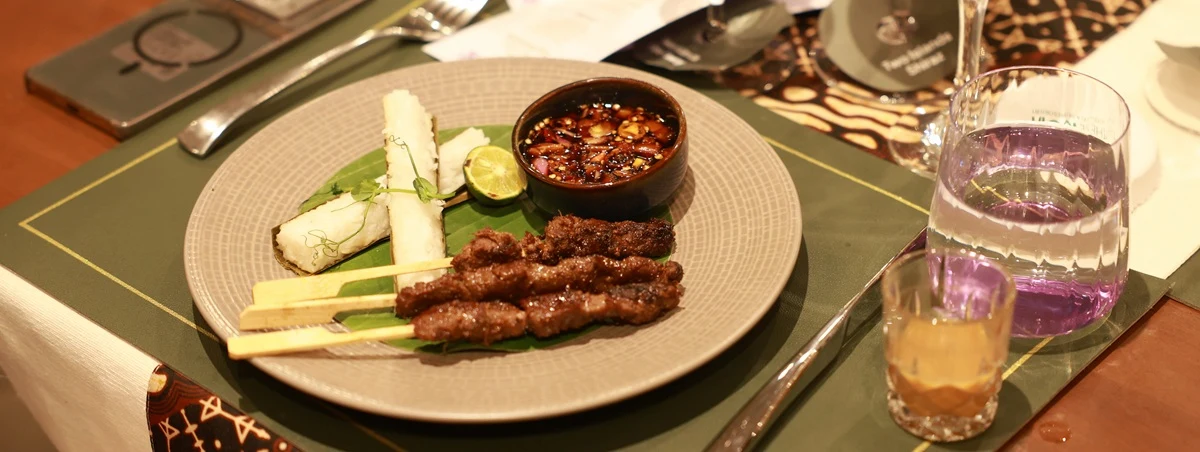
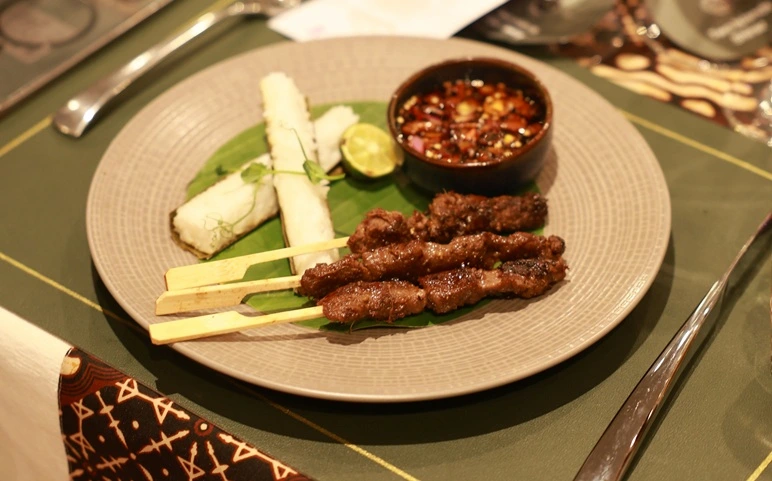
For the main course, Sate Maranggi represented one of Indonesia’s celebrated culinary specialties.
Known for its rich seasoning, savory character, and distinctive smoky aroma from the grilling process, Sate Maranggi was paired with Two Islands Shiraz from Hatten Wines.
The wine’s rich fruit character complemented the savory and smoky notes of the grilled satay, creating a pairing designed to enhance the dish without overpowering its original character.
This pairing demonstrated that the evening’s exploration extended beyond cooking techniques. It also explored how Indonesian culinary heritage can be introduced to the traditions of wine pairing to create a more complete gastronomic experience.
When Chocolate Meets Snake Fruit from Sleman
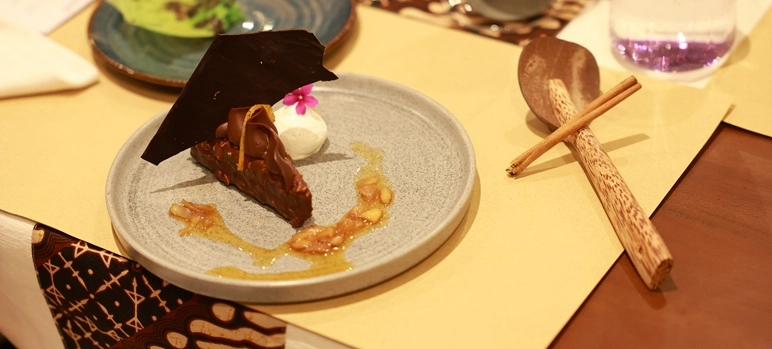
The culinary journey concluded with an unexpected yet harmonious pairing of chocolate and snake fruit, two ingredients with contrasting characteristics that came together in a distinctive dessert.
The Flourless Chocolate 57%, Marquissa Snakefruit, Delicatessen A La Minute was created by Chef Gerald Maridet, Artisan Pastry, bringing together his French pastry background with the richness of Indonesian ingredients.
The inspiration for the dessert came from Sleman, where Chef Gerald lives and where snake fruit is one of the region’s distinctive agricultural products.
According to Chef Gerald, the creation was inspired by his desire to connect his French pastry background with the local ingredients and stories surrounding his everyday environment.
Chocolate and snake fruit were chosen for their contrasting characteristics, which create an intriguing balance of flavors.
The richness and intensity of the chocolate allow the natural character of the snake fruit to remain present, while giving the dessert a distinctly Indonesian identity.
The dessert was paired with Two Islands Fine Tawny, whose rich and sweet character complemented the chocolate and fruit elements of the final course.
Before the signature dessert, guests were also introduced to Kue Ape, a traditional Indonesian street snack that brought a sense of nostalgia and the richness of Indonesia’s street food culture into the contemporary gastronomic experience.
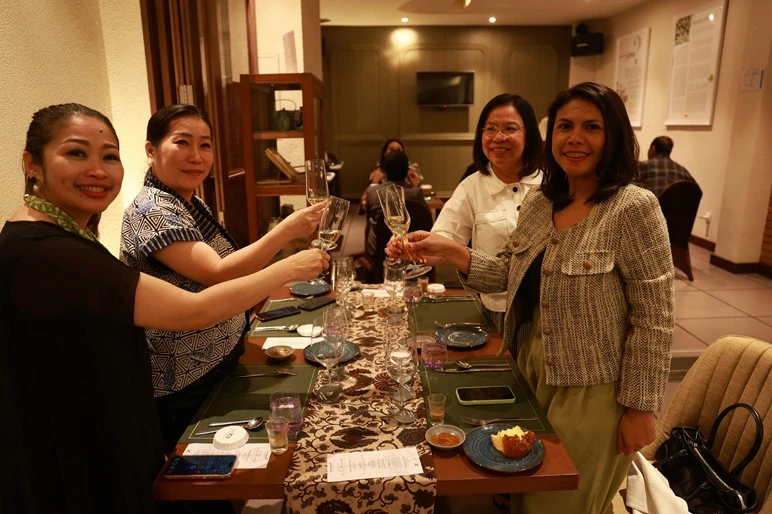
More Than Fusion: A Dialogue Between Culinary Traditions
What sets Nusantara A La Francaise apart is its approach, which goes beyond simply combining Indonesian and French ingredients in a single dish.
The collaboration explored how culinary techniques, ingredient selection, presentation, and food-and-wine pairing can create new interpretations of Indonesian cuisine while preserving the character and stories behind each dish.
From coconut milk and spices in the Soto Betawi-inspired interpretation, to bakwan jagung as an appetizer, the smoky character of Sate Maranggi, and Sleman snake fruit paired with chocolate, each dish became part of the same story: Indonesia’s rich culinary heritage can continue to evolve through exploration without losing its roots.
For THE 1O1 Jakarta Sedayu Darmawangsa, the experience is also part of its continued commitment to exploring and introducing Indonesia’s culinary heritage through creative and relevant experiences at Dwangsa9 Indonesian Restaurant.
The Collaboration Continues with Christmas & New Year Hampers
The evening concluded with a special announcement regarding the continuation of the collaboration between THE 1O1 Jakarta Sedayu Darmawangsa and PT. Pandurasa Kharisma through a forthcoming Christmas & New Year Hampers collaboration.
The hampers will feature artisan chocolate from PT. Pandurasa Kharisma as one of their key elements, complemented by a selection of wines from Hatten Wines.
The continuation of this partnership represents the next chapter in creating experiences that bring together product quality, creativity, craftsmanship, and inspiration drawn from Indonesia’s rich cultural heritage in a festive offering for the year-end season.
Through Nusantara A La Francaise, THE 1O1 Jakarta Sedayu Darmawangsa demonstrates that Indonesian culinary heritage does not have to remain confined to its traditional forms. Through new techniques and perspectives, Nusantara flavors can continue to evolve, adapt, and reach a broader gastronomic audience—without losing the stories and identity at their roots.