

 Mirella Pandjaitan
 Jan 09, 2026
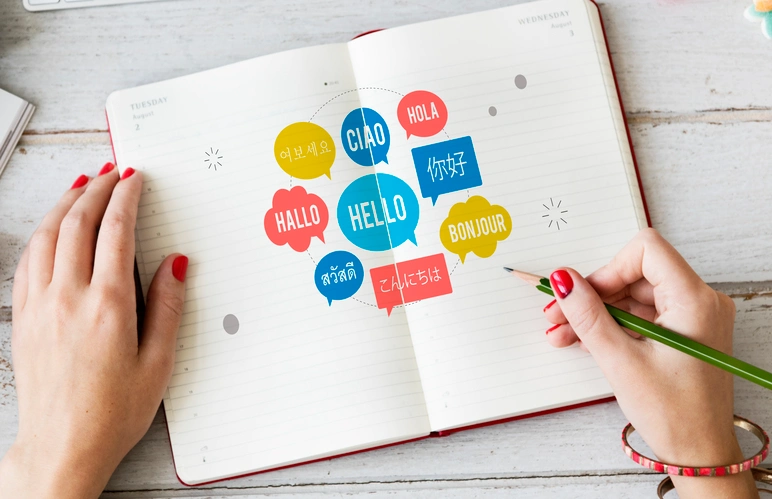
In a world imbued with the next “big thing”, reverting back to basics has never been more necessary. Learning a new language could be a necessity. It could also be a hobby; a private space for curiosity and pleasure, a counterbalance to productivity where the self can expand without expectation. A hobby quietly sharpens the mind, steadies the spirit, and reminds us that growth is not always measured in outcomes, but in presence.
Some might consider a new language as their ticket to a life upgrade, whereas others simply lean into the excitement. A language can feel like home — familiar, grounding, emotionally charged. It carries memory and meaning, humour and nuance. To speak it fluently isn’t merely practical; it's an act of connection, a tether to heritage and culture. To learn it is a means to rediscover parts of oneself long left unexplored.
How can words shape who we are? Treat it as the gateway to identity — a neat, elegant idea, though not entirely complete. We are, after all, shaped by far more than the words we speak. Our values, our histories, our lived experiences all leave their imprint. Yet language remains one of the most intimate markers of who we are: the way we articulate emotion, claim belonging, and move through the world.
Diana Syarah is globally attuned. Her love for watching movies, reading books, and sometimes playing video games initiated her journey to dwell in foreign expressions. “My brain is like a small-scale UN,” she chuckles. This self-proclaimed polyglot speaks five languages: Indonesian, Sundanese (her mother tongue), French, Italian (slightly), English, and now Mandarin.
English was Diana's first foreign language. Her mother compelled her to learn it, which she states has zero regrets over. Since a kid, Diana exposed herself to English films and music. She even read books like Cinderella and Donald Duck and some comics too.
The most dominant language she communicates with is English. She even thinks in English. As a journalist who's curated outputs in both English and Indonesian, Diana finds English to be more active, compact, and efficient. “When I report in Indonesian, I feel frustrated—I have to be so detailed, floating around words with compound phrases. It almost feels restrictive and ineffective. English is the complete opposite! It’s like comparing a sprint to a marathon,” she details.
Her adoration over French cinema, on the other hand, enchanted her into studying French for her Bachelor’s degree. Her French nowadays comes in handy at certain points, namely impressing a French chef at a restaurant or supporting the French national team.
“Italian is very similar to French grammatically, so it was a natural next step,” she states. Diana remains open to learning Japanese since she'd always loved anime and the culture around it. “I’ve tried a bit of Japanese—it’s not too hard, and it’s kawaii [cute].”
Challenges in learning a new language
Jamie Mcilroy left the laid-back Northern Beaches of Sydney, Australia as an arborist/horticulturalist (someone who specialises in trees and plants) to a life between the mist-kissed dream and contemporary ease within the Java island. Playing golf claims the calm corners of his time, beyond his work to teach students the tips, tricks, strategies, and approaches for each IELTS skill.
These days, everyone has to learn another language, whether it’s English alongside their local language or dialect in this day and age. As for whether it’s difficult, that solely depends on the amount of effort and commitment someone puts into learning.
Younger children who learn languages early, especially in bilingual schools, pick it up much more easily. Adults who haven’t had that exposure and mostly rely on subtitles or limited interaction with English find themselves tested more sharply.
Out of the five, French used to be the most intricate one for Diana. French, she explains, has three genders, multiple conjugations, and distinctive forms of past tense in older literature. Mandarin now takes the reins as the “incredibly challenging” one, limiting her ability to only reading pinyin, not the characters.
“My experience with learning Mandarin was very different. I forget things more easily now. Grammar isn’t the problem, it’s the pronunciation and unique word usage. Mispronounce a word and the meaning changes entirely,” she details.
“I quit Mandarin after ten months because it's too overwhelming. But one day I’ll go back. I still practice a bit on Duolingo—my motivation is to beat someone I know who’s also learning on the app!”

According to Jamie, the primary hurdle in language learning is that students are mostly taught grammar but have limited communicative practice. “Their productive skills—speaking and writing—are often underdeveloped. This applies across age groups, especially in IELTS,” he notes.
Another major challenge is that once students leave the classroom, they immediately revert to speaking Indonesian. Improvement becomes daunting in every sense when deprived of everyday English use. However, having the opportunity to speak English at home with siblings or family, flows with effortless grace. Diana speaks French to her feline companion, for instance.
Jamie can relate with his pursuit of Indonesian fluency. Confidence takes hold when he speaks Indonesian regularly for a week, per say; once stopped, it deteriorates swiftly. “I start questioning grammar, word order, and vocabulary—just like my students do,” he reflects.
Benefits of learning a language as a hobby
To learn a language is not simply to acquire a skill. It refines perception, expands identity, and engages more fully with the world. Quietly, beautifully, word by word.
Adults are proven to be exceptionally equipped to learn languages. Childhood fluency is usually romanticised, overlooking the advantages that arrive with age.
Diana admits learning as an adult is more rigorous mostly because her memory isn’t as flexible. “When you’re young, your brain is a memory storage room. When you’re older, it’s like a curated gallery—you pick what stays and what goes. Now, I have to repeat material multiple times! But if you love the language, persistence makes all the difference,” she expresses.
Studies have proven that adults bring powerful tools when approaching a new language, such as cognitive maturity, pattern recognition, and contextual understanding. Abstract concepts, nuance, and structure are easier to grasp when the mind is already well-trained.
More than that, adults understand themselves. They know how they learn, where they struggle, and which strategies serve them best. This self-awareness allows for a tailored, intentional approach, one guided by reflection rather than trial alone.
Motivation, too, is sharper. Adult learners are rarely accidental. They are driven by purpose: heritage, career, connection, curiosity. Clear goals provide focus, and focus sustains effort.
Modern resources only amplify these strengths. From immersive platforms to language exchanges and on-demand courses, today’s learner can design an experience as flexible or structured as they choose.
Not to mention, language learning is deeply active. It sharpens memory, challenges cognition, strengthens problem-solving skills. Research consistently links bilingualism with improved mental agility and even long-term brain health.
Citizens of developed countries learn a new language at school, but Jamie acknowledges it’s a different spectrum for those from developing countries. Learning a second language opens doors. Educationally, it grants opportunities for further study and international education; and socially, it enables people to communicate with foreigners and navigate other countries.
Beyond the intellectual benefits lies abundance, since language is culture made audible. To learn it is to step inside another way of seeing — to understand humour, tradition, values, and rhythm from the inside out.
It transforms travel from observation into participation. Films lose their subtitles, books reveal their original tone, conversations deepen. More importantly, it expands connection — with colleagues, strangers, friends — bridging differences through shared understanding. “English lets me enjoy films without subtitles, French lets me follow French movies and music, and Mandarin introduces me to Chinese culture. It makes you more curious, more diverse, more culturally literate,” remarks Diana.
However, Jamie views there’s a downside, especially in Indonesia. While learning English brings clear benefits it may not be beneficial on a local cultural level. As students prioritise English or Mandarin, local dialects are being neglected. “Over time, these local languages will die out. Language is culture and identity, and that loss is already happening,” he reckons.
How to learn languages as a hobby

Start by finding your why. Motivation is everything, and it’s rarely abstract. Perhaps it’s to ask for directions from someone at a warung, to haggle at a market for a good price, or the simple desire to order a nasi campur without hesitation. Whatever the reason, anchor yourself to it. Language learning is sustained not by discipline alone, but by desire.
Diversify the experience as no single method can carry you all the way. Language is textured, lived, multifaceted. Try everything on. Keep what fits. Variety keeps the process alive, and engagement deepens understanding.
Diana suggests starting with something enjoyable. Watching a film or series properly, in this case, implies switching the subtitles and audio. Yes, it will feel disorienting at first, which is precisely the point. Choose a familiar show and let your brain do the work. “Watch movies—you see how people really speak. If it sparks interest, try an app or a tutor. The key is intrinsic motivation: love the language first, and learning follows naturally,” she enthuses. One day, without warning, comprehension clicks. And suddenly, all those hours feel quietly triumphant.
To Jamie, learning a language as a hobby isn't purely about learning the language but also the culture. “People are free to learn whatever interests them. It always comes back to commitment and discipline,” Jamie claims. “Some just want to learn a few Korean words to watch dramas—that’s fine. People pick up vocabulary through exposure, even with subtitles. We all go through fads, and that’s okay. The level of proficiency someone reaches depends entirely on how much effort they invest.”
Fluency doesn’t begin with grand gestures or expensive courses. It starts quietly. A daily app, a local conversation group, a few minutes stolen between errands. Choose the method that feels light, even joyful, and begin there — with curiosity rather than pressure. Momentum will follow.
Committing to the ritual can be weighty. Understandably so in the early stages; progress feels slow, life is full, motivation wavers. But routine is a game changer. When language learning becomes part of your day — a lunchtime ritual, a morning habit — it no longer requires negotiation. It simply happens.
Tips for adults on their learning journey
Many Indonesian adults, especially, didn’t get the exposure younger generations have now. Children are taught grammar in school and often at a higher level. Many are learning English across multiple subjects, not just in language class. Adults won’t reach the same level as children who grow up bilingual—but that’s okay, reminds Jamie.
One big misconception is that learners focus too much on grammar. Instead, Jamie defines language learning as starting with vocabulary. Identify sports, food, shopping, activities, and so on. Then, proceed to build sentences. “Mistakes are part of learning. If you’re afraid of them, you’ll never improve,” he emphasises. Fluency and pronunciation come with time.
“One can never perfect a second language, so focus on getting your message across. Even when I speak Bahasa, I don’t care if I’m wrong—as long as I’m understood,” he declares. “Confidence matters too. People hesitate because they’re afraid of mistakes. But mistakes are part of learning. Don’t worry about being perfect!”
Diana urges adults to be consistent because even small steps count. Love it first, and the desire to continue follows. Otherwise, quitting becomes a greater option.
As Diana enunciates it: “Language is like love. Love and language both need practice, repetition, attention, and passion...
Language, like love, dies if you don’t practice it every day.”